Fire Escape Ladder: A Designer’s Review for Real Projects
As a designer who has spent countless hours digitizing and stitching out thousands of patterns, I have learned to look past the flashy preview images. What matters is how a design behaves under the needle. When I first loaded the Fire Escape Ladder machine embroidery design into my software, my initial reaction was one of appreciation for its structural simplicity. It is not cluttered with unnecessary flourishes or overly complex gradients that often cause thread breaks on home machines. Instead, it offers a clean, graphic representation that speaks to both function and form.
This piece falls squarely into the Work category, yet its versatility allows it to transcend strict industrial themes. Whether you are creating safety-themed educational materials or simply looking for a bold geometric accent, this ladder motif holds its own. In this review, I will walk you through how this design performs in real-world scenarios, from custom apparel to boutique merchandise, and what you need to know before you hit start on your machine.
First Impressions and Visual Personality
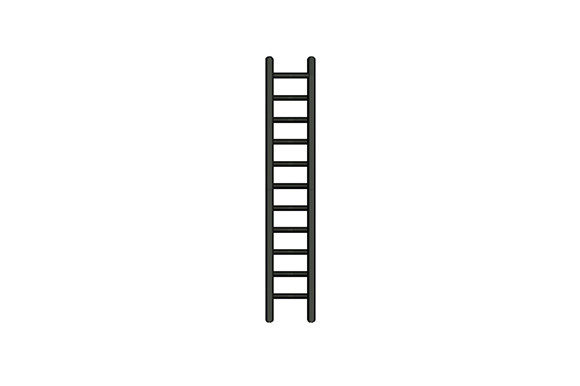
The mood created by the Fire Escape Ladder is one of stability and ascent. Visually, it is linear and rhythmic. The rungs provide a natural repetition that is pleasing to the eye, while the side rails offer strong vertical lines that guide the viewer’s gaze upward. For an embroidery project, this translates well because straight lines and consistent spacing are generally easier to stitch cleanly than organic, free-flowing shapes.
I appreciate that the design does not rely heavily on dense fill stitches to make its point. This suggests a lighter touch, which is crucial for maintaining the drape of fabrics like cotton twill or jersey knits. The visual personality is modern and utilitarian, making it an excellent choice for brands that value transparency, growth, or safety. It feels honest, which is a rare quality in decorative embroidery.
Real-World Application: The Custom Tote Test
To truly evaluate an embroidery file, I believe in putting it to work. Recently, I prepared a batch of canvas tote bags for a local community center focused on urban safety awareness. I chose the Fire Escape Ladder as the central graphic. The goal was to create a handmade product that felt professional but approachable.
Stitching this design onto medium-weight canvas was straightforward. The linear nature of the ladder allowed me to use a combination of satin stitch for the rails and a lighter fill or running stitch for the rungs, depending on the scale. The result was crisp. The contrast between the bright yellow thread I selected and the natural beige canvas made the design pop without looking garish. Customers at the craft fair were drawn to the clarity of the image. It wasn’t just a logo; it was a conversation starter about safety and preparedness.
This experience highlighted why this design works so well for Etsy sellers and small shop owners. It is recognizable even from a distance, which is vital for products displayed on crowded tables or in online thumbnails. For a sweatshirt embroidery project, this same clarity ensures the design remains legible even when the fabric bunches slightly during wear.
Navigating Fabric and Hoop Constraints
While the Fire Escape Ladder is forgiving, it is not without its technical demands. As an experienced reviewer, I must point out where caution is needed. If you are working with textured fabrics, such as terry cloth towels or heavy wool blankets, the finer details of the rungs might get lost. In these cases, increasing the stitch density slightly or choosing a thicker thread weight can help maintain visibility.
For stretchy fabrics like those used in baby embroidery or athletic wear, proper stabilization is non-negotiable. The vertical lines of the ladder can distort if the fabric shifts during stitching. I recommend using a cut-away stabilizer for garments that will undergo frequent washing, such as t-shirts or aprons. For a one-time gift item or decorative pillow cover, a tear-away might suffice, but always test on scrap fabric first.
Curved surfaces present another challenge. If you are applying this design to a cap or a rounded mug sleeve, the straight lines of the ladder may appear to bow if not hooped perfectly straight. Take your time with the hooping process. Use a laser level or grid lines on your hoop to ensure the design is perpendicular to the ground. This attention to detail separates amateur handmade products from professional commercial embroidery assets.
Enhancing Brand Value and Customer Trust
For creative entrepreneurs, the choice of design assets directly impacts brand consistency. The Fire Escape Ladder offers a level of professionalism that builds customer trust. It does not look like a clip-art afterthought; it looks intentional. When used in personalized gifts, such as a firefighter’s retirement present or a new parent’s nursery decor, it conveys thoughtfulness.
The design’s simplicity also makes it highly adaptable for digital embroidery file previews. When creating printable mockups for your online store, the clean lines render beautifully in black and white or grayscale. This allows potential buyers to visualize the design on various background colors without the distraction of complex shading. For an Etsy seller, this versatility can lead to higher conversion rates because customers can easily imagine the finished product in their own color scheme.
Practical Notes for the Embroiderer
Before you commit to a large production run, consider these practical steps:
- Check Thread Contrast: Since the design is linear, high contrast between the thread and fabric is essential. Test light threads on dark fabric and vice versa.
- Review Stitch Density: If your machine allows, adjust the density to suit your fabric. Too dense on thin fabric, and you risk puckering; too sparse on thick fabric, and the backing may show through.
- Confirm Hoop Size: Ensure the design fits comfortably within your hoop with adequate margin for clamping. Do not crowd the edges.
- Inspect Small Details: Zoom in on your software to check for any tiny jump stitches or unnecessary trims that could slow down your machine.
- Verify Licensing: Always confirm whether the embroidery file permits commercial use. If you plan to sell finished items or digital products, ensure you have the correct license from the creator.
In conclusion, the Fire Escape Ladder is a robust addition to any designer’s library. It bridges the gap between thematic specificity and general aesthetic appeal. Whether you are decorating a kitchen towel for a housewarming gift or branding a line of workwear, this design delivers clarity and style. It respects the limitations of the embroidery process while maximizing visual impact. For makers who value precision and practicality, this is a pattern worth stitching.