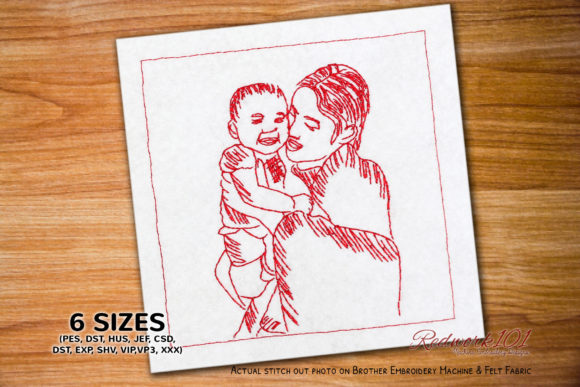
Review: Mom Kissing Little Boy Embroidery Design
As a designer who has spent countless hours digitizing and testing machine embroidery designs, I have learned that sentimentality alone does not make a successful stitch-out. The emotional weight of a design must be balanced by technical precision, especially when the subject matter is as tender as Mom Kissing Little Boy. This particular redwork-style design caught my eye not just for its theme, but for its potential versatility in a commercial craft business. When evaluating a new embroidery file, I look beyond the preview image to understand how it behaves under the needle on various fabric textures and hoop sizes.
First Impressions and Visual Mood
The immediate impression of Mom Kissing Little Boy is one of quiet intimacy. Unlike complex fill stitch portraits that can become muddy on smaller scales, this design relies on clean lines and negative space, characteristic of traditional redwork. The simplicity allows the viewer’s eye to focus on the connection between the figures rather than getting lost in excessive detail. For an experienced reviewer, this minimalism is a strength. It suggests that the design will remain legible even when scaled down for smaller items like baby onesies or embroidered patches.
The optional Box Stitch mentioned in the product description adds an interesting layer of customization. While the core silhouette stands strong on its own, the frame provides a structured boundary that can help anchor the design on larger surfaces like tote bags or pillow covers. However, from a practical standpoint, I appreciate that the box is optional. This flexibility allows us to adapt the artwork for different products without feeling constrained by a rigid border.
Real-World Application and Product Fit
To truly test the viability of Mom Kissing Little Boy, I imagined it in several real-life production scenarios. The most natural fit is undoubtedly for Mother S Day collections. An Etsy seller could easily incorporate this into a line of personalized gifts, such as custom aprons for grandmothers or tea towels for new moms. The redwork aesthetic pairs beautifully with natural linen or cotton canvas, creating a rustic, handmade product feel that resonates with buyers looking for authenticity.
I also considered its application on custom apparel. On a sweatshirt, the design would sit comfortably on the left chest or centered on the back. Because redwork typically uses running stitch or simple satin stitch outlines, the resulting embroidery is lightweight and flexible. This is crucial for garments that need to drape well and remain comfortable against the skin. For baby embroidery projects, such as bibs or burp cloths, the lack of dense fill stitches means the finished product will be softer and less likely to irritate sensitive skin.
For those running a small shop product line, this design offers excellent value as a digital embroidery file. It can be marketed as a quick-stitch option, appealing to customers who want high-quality decoration without long machine run times. Whether used for holiday embroidery gifts or year-round boutique branding, the timeless nature of the subject matter ensures it does not feel dated after a single season.
Technical Considerations and Stitching Performance
While the design is visually appealing, practical execution requires attention to detail. Redwork designs are deceptively simple; because they rely on single-color thread paths, any inconsistency in tension or registration becomes immediately visible. When stitching Mom Kissing Little Boy, I recommend using a high-quality polyester or rayon thread to ensure smooth coverage and consistent sheen.
Fabric choice plays a pivotal role here. On textured fabrics, such as terry cloth or heavy denim, the fine lines of the design might get lost. In these cases, increasing the stitch width slightly or adding a backing stabilizer with higher tear strength can help maintain clarity. Conversely, on thin or stretchy fabric, proper hooping and cut-away stabilizer are non-negotiable to prevent puckering. Since the design features curved lines representing the embrace, any distortion in the fabric will be noticeable in the final silhouette.
Density is another factor. Although redwork is generally low-density, the optional box frame could add unnecessary bulk if not managed correctly. If you choose to include the box, ensure your machine settings are optimized to prevent thread breaks at the corners. For curved surfaces like caps, I would advise testing the design without the box first, as the rigid square shape may not conform well to the panel’s curvature without significant adjustment.
Enhancing Brand Value and Customer Trust
From a business perspective, the quality of your embroidery project directly impacts customer trust. A clean, crisp stitch-out of Mom Kissing Little Boy signals professionalism. It shows that you care about the finished product, not just the speed of production. This attention to detail can justify a higher price point for handmade products and encourage repeat business.
When creating printable mockups or digital product previews, consider showing the design on both light and dark backgrounds. The contrast of red thread on white linen is classic, but testing it on navy or black fabric can reveal how versatile the design truly is. If the lines remain distinct and the emotional impact is preserved across different colorways, you have a robust asset for your design assets library.
Practical Designer Notes
Before committing to a full production run, always test the design on scrap fabric similar to your final material. Check the stitch density to ensure it does not perforate delicate fabrics. Verify the hoop size required; while this design appears compact, confirm that it fits within your standard hoops without excessive re-hooping.
Inspect small details closely. Are there any jump stitches that need trimming? Is the start and end point secure? These minor adjustments can save time during post-processing. Additionally, confirm licensing terms before selling finished items. While many digital embroidery files allow for commercial use, it is essential to read the specific agreement provided by the creator to avoid legal issues.
Finally, consider the thread colors. While red is traditional for redwork, experimenting with soft pastels for baby items or deep burgundy for autumn-themed decor can expand your market appeal. The key is maintaining enough contrast between the thread and the fabric texture to keep the image clear.
In conclusion, Mom Kissing Little Boy is a thoughtful addition to any embroidery designer’s portfolio. Its balance of emotional resonance and technical simplicity makes it suitable for a wide range of applications, from personalized gifts to commercial merchandise. By paying attention to fabric choice, stabilizer selection, and stitch quality, you can transform this digital file into a cherished keepsake that honors the enduring bond between mother and child.